Papers
The Logic Realism Theory paper suite
The LRT research programme consists of a coordinated suite of papers, each building on the foundational framework while addressing specific derivations and extensions.
Core Framework
Logic Realism Theory: Physical Foundations from Logical Constraints
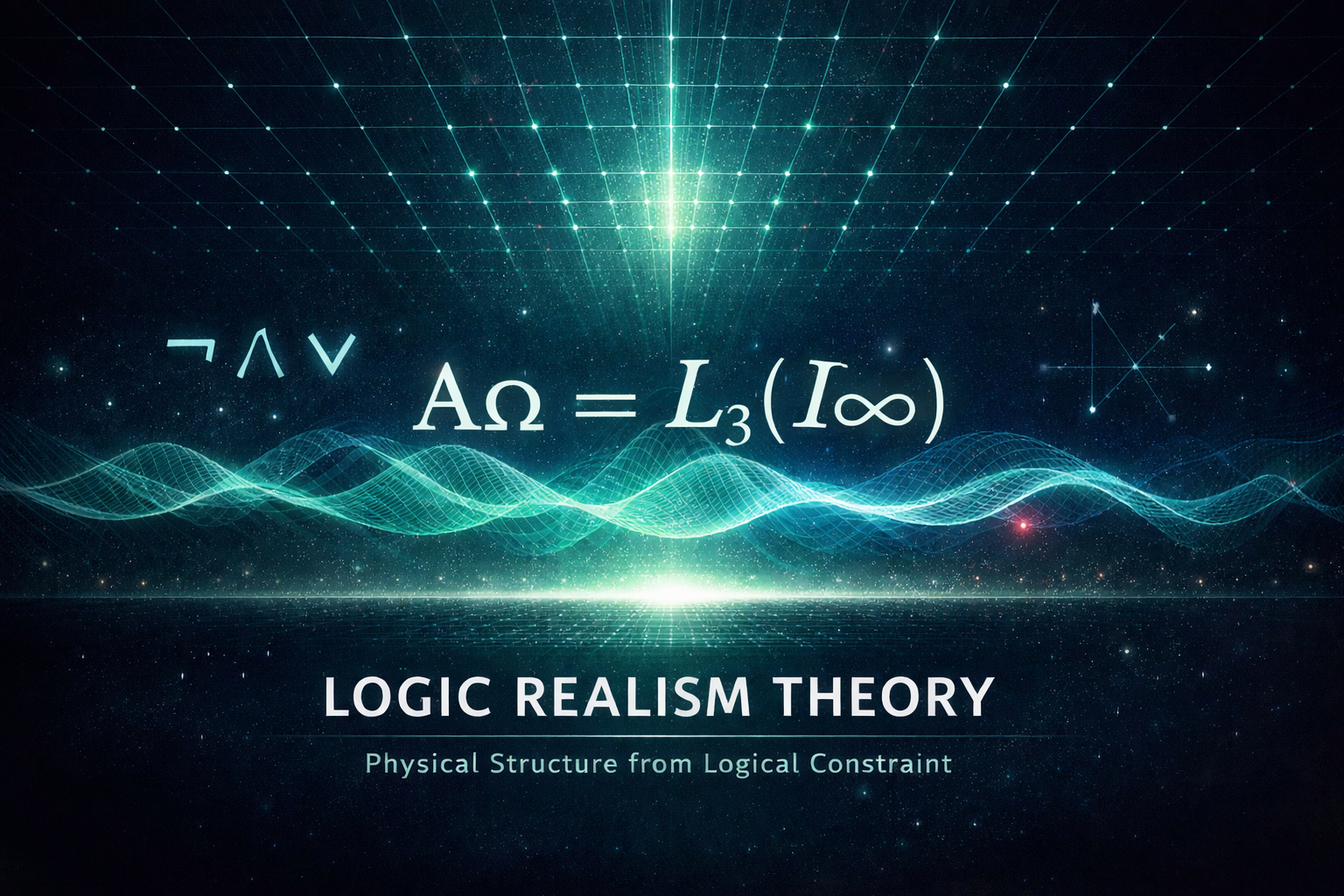
The foundational Position Paper establishing the $I_\infty$/$A_\Omega$ ontology, the vehicle/content distinction, and the core thesis that $L_3$ (Identity, Non-Contradiction, Excluded Middle) constrains physical instantiation.
Read Paper →It from Bit, Bit from Fit: Foundational Physics Logically Remastered
Extends LRT to quantum mechanics, arguing that quantum structure is the unique stable interface between $I_\infty$ and $A_\Omega$. Grounds Wheeler's "it from bit" in logical foundations.
Read Paper →Logic Realism Theory: Philosophical Foundations (v3, Tahko)
Revised philosophical foundations paper engaging Tahko's work on grounding and ontological dependence. Situates LRT within contemporary analytic metaphysics, clarifying the relationship between logical admissibility and physical necessity.
Download PDF →Technical Derivations
Deriving the Born Rule from Logical Constraint: A Logic Realism Theory Approach
Full five-stage derivation of the Born rule from L₃ constraints. Presents two complementary routes (via reconstruction and via Hilbert space assumption), formal axioms A1–A7, explicit mapping to Masanes–Müller reconstruction, and comprehensive literature connection. Peer-review ready.
Read Paper →The Born Rule from Determinate Identity (earlier version)
Earlier, more concise treatment. Derives the Born rule ($|\langle\phi|\psi\rangle|^2$) from vehicle-weight invariance. Shows that Determinate Identity forces the additivity and non-contextuality conditions required by Gleason's theorem.
Read Paper →Complex Hilbert Space from Determinate Identity
Derives complex Hilbert space structure from Determinate Identity via local tomography. Shows that the Masanes-Müller axioms are consequences of $L_3$ constraints, not independent postulates.
Read Paper →Quantum Statistics from Determinate Identity
Derives the symmetrization postulate (bosons/fermions) from Determinate Identity applied to systems of identical particles. Shows that permutation symmetry is forced by $L_3$, not an independent axiom.
Read Paper →Extensions
Spacetime from Determinate Identity
Explores consequences of Determinate Identity for spacetime structure. Derives temporal ordering from joint inadmissibility, argues for Lorentzian signature, excludes closed timelike curves. Programmatic.
Read Paper →Computational
Numerical Exploration of Information Circulation Cosmology
Computational study of the ICH dark energy mechanism. Demonstrates Λ-like behavior ($w_\text{eff} \approx -1$) across parameter space, assesses fine-tuning, and compares with SNe Ia distance modulus observations.
Read Paper →AI Systems / Related Work
Demonstrating Structural Drift Stabilization in Autoregressive Transformers
Empirical study of structural drift in autoregressive transformer models and methods for stabilization. Related to LRT's treatment of representational stability and the admissibility constraints that govern coherent inference over extended sequences.
Download PDF →Reading Order
For readers new to LRT, we recommend:
- Position Paper — Start here for the core framework
- Born Rule Derivation (2026) — Full five-stage derivation with formal axioms (recommended)
- Hilbert Space Paper — Completes the quantum structure derivation
- It from Bit — Conceptual synthesis and Wheeler connection
- QFT Statistics — Extension to particle statistics
- GR Extension — Programmatic spacetime implications
- Philosophical Foundations v3 (Tahko) — Metaphysical grounding and analytic context
- ICH Simulation — Computational exploration (optional, in progress)
Note: The 2025 Born Rule paper is an earlier, more concise version superseded by the 2026 derivation.
Each paper can be read independently, but together they form a unified derivation from foundational logic to quantum mechanics and beyond.
Citation
All papers are archived on Zenodo with persistent DOIs. Please cite the archived versions for academic reference.