Logic Realism Theory
Physical Foundations from Logical Constraints
The Core Thesis
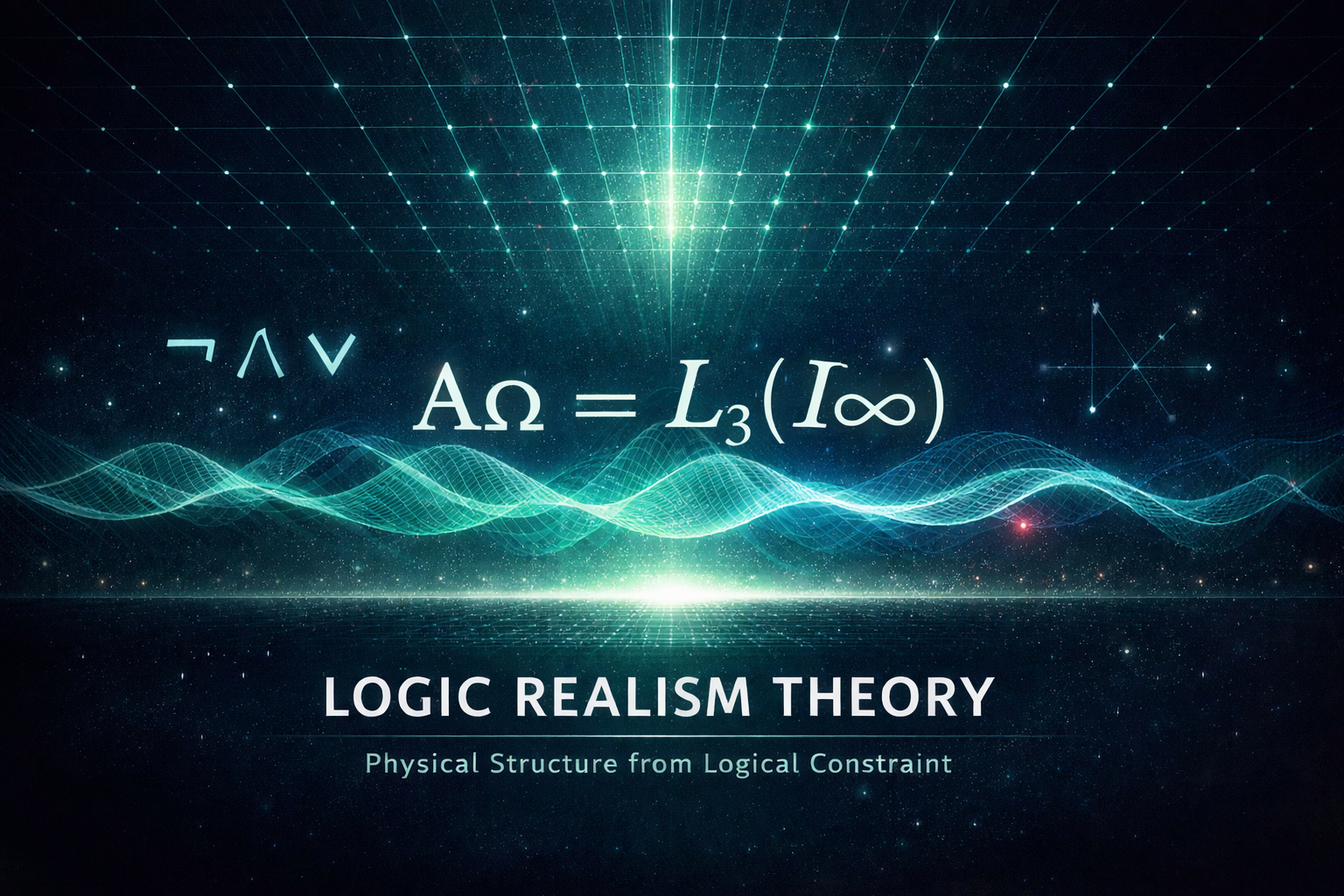
Logic Realism Theory (LRT) proposes that the three classical logical laws—Determinate Identity, Non-Contradiction, and Excluded Middle (collectively $L_3$)—function as ontological constraints on physical instantiation, not merely rules of inference. This approach to the logical foundations of physics offers an alternative to ontic structural realism by grounding quantum structure in logical admissibility rather than primitive physical relations.
The framework distinguishes:
- $I_\infty$: The space of all representable configurations (including contradictions and impossibilities)
- $A_\Omega$: The $L_3$-admissible subset that can be physically instantiated as stable records
This boundary condition generates quantum structure. Vehicle-invariance under mathematically equivalent decompositions forces the Born rule via Gleason’s theorem. Local tomography requirements select complex Hilbert space over real alternatives. The framework provides a derivation of the Born rule from first principles and addresses core problems in quantum ontology through logical constraints rather than postulates.
It from Bit, Bit from Fit: Physical structure emerges from informational structure, which emerges from logical admissibility.
The programme connects to broader questions in the philosophy of physics, offering novel predictions that distinguish it from interpretive competitors. The requirement for complex (rather than real) quantum mechanics was confirmed by Renou et al. (2021), providing empirical support for the logical realism approach.
Research Programme
LRT is a Lakatosian progressive research programme with:
- Hard core: $L_3$ as constraints on physical instantiation
- Protective belt: Vehicle-invariance formulation, Hilbert space representation, interface criteria
- Novel predictions: Complex QM requirement (confirmed by Renou et al. 2021), derivable collapse parameters, Tsirelson bound
The programme derives quantum structure rather than postulating it:
| Result | Derived From |
|---|---|
| Born rule ($|\psi|^2$) | Vehicle-invariance (Determinate Identity) |
| Complex Hilbert space | Local tomography requirement |
| Symmetrization postulate | Identity constraints on identical particles |
| Tsirelson bound | Hilbert space structure |
Paper Suite
Position Paper
Core framework establishing $I_\infty$/$A_\Omega$ ontology, vehicle/content distinction, and the derivation of quantum structure from logical constraints.
Read Paper →Born Rule Derivation
Derives the Born rule ($|\langle\phi|\psi\rangle|^2$) from vehicle-weight invariance via Gleason's theorem.
Read Paper →Hilbert Space Derivation
Derives complex Hilbert space structure from Determinate Identity via local tomography requirements.
Read Paper →QFT Statistics
Derives the symmetrization postulate (bosons/fermions) from Determinate Identity applied to identical particles.
Read Paper →Spacetime Extension
Explores consequences of Determinate Identity for spacetime structure: temporal ordering, Lorentzian signature, CTC exclusion.
Read Paper →It from Bit, Bit from Fit
Grounds Wheeler's "it from bit" in logical foundations. Quantum mechanics as the unique stable interface between $I_\infty$ and $A_\Omega$.
Read Paper →Information Circulation Hypothesis
The Information Circulation Hypothesis (ICH) extends LRT to cosmology: black hole horizons serve as $L_3$-instantiation boundaries where information de-actualizes (returns to $I_\infty$) and re-actualizes (joins $A_\Omega$). The net circulation imbalance produces an effective cosmological constant without fine-tuning.
ICH: Operationalization
The flagship ICH paper. Closes the L₃ → Adm gap via horizon physics. Makes assumptions explicit (A1-A5), derives Adm from boundary distinguishability constraints, connects to Λ as circulation fixed-point. JHEP/PRD ready.
Read Paper →ICH: Conceptual Introduction
Accessible overview of the core idea: black holes as de-actualization mechanisms returning information to $I_\infty$. Start here for intuition before the formal treatment.
Read Article →ICH: Numerical Exploration
Computational demonstration that influx/outflux imbalance produces $\Lambda$-like behavior ($w_\text{eff} \approx -1$) across broad parameter ranges without fine-tuning.
Read Paper →Simulations
ICH Dark Energy Notebooks
Toy simulations exploring how influx/outflux imbalance can drive late-time cosmic acceleration. Includes baseline model and parameter sensitivity analysis.
View Notebook →Author
James (JD) Longmire
- ORCID: 0009-0009-1383-7698
- Email: jdlongmire@outlook.com
- GitHub: jdlongmire
AI Assistance Disclosure: This work was developed with assistance from AI language models including Claude (Anthropic), ChatGPT (OpenAI), Gemini (Google), Grok (xAI), and Perplexity. All substantive claims, arguments, and errors remain the author’s responsibility. Human-Curated, AI-Enabled (HCAE).
Archives
- Definitions & Glossary — Key terminology and concepts
- How to Cite — BibTeX, DOIs, and citation information
- Zenodo Community — Persistent DOI-minted archives
- GitHub Repository — Source code, proofs, and development history